

English Language and Literature
English Language and Literature
Our Vision
Servant Leaders who think critically, communicate effectively, and lead with empathy and integrity.
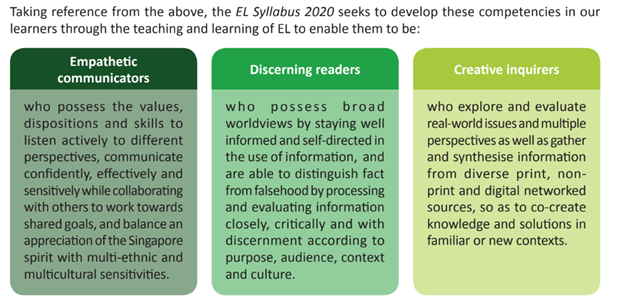
Taking reference from the EL Syllabus 2020, the teaching and learning of EL would enable students to be:
Our Mission
To meet the language-learning needs of young men in the 21st Century by developing life-long learners who are confident and able users of the English language. As concerned citizens and active contributors, they will become:
-
creative (yet structured) writers;
-
confident (yet sensitive) speakers;
-
careful (yet curious) listeners; and
-
critical (yet open) readers and viewers.
EL Curricular Approach
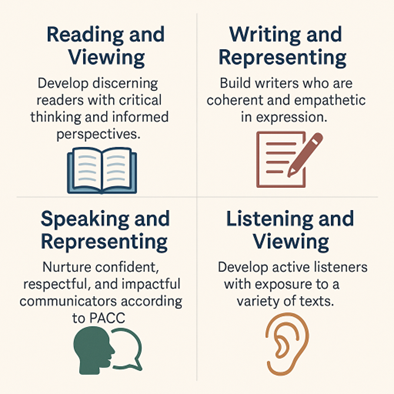
Aligned with the four areas of language learning stipulated in the EL Syllabus 2020, the approach at SAS(S) develops Saints who are effective in each domain as shown:
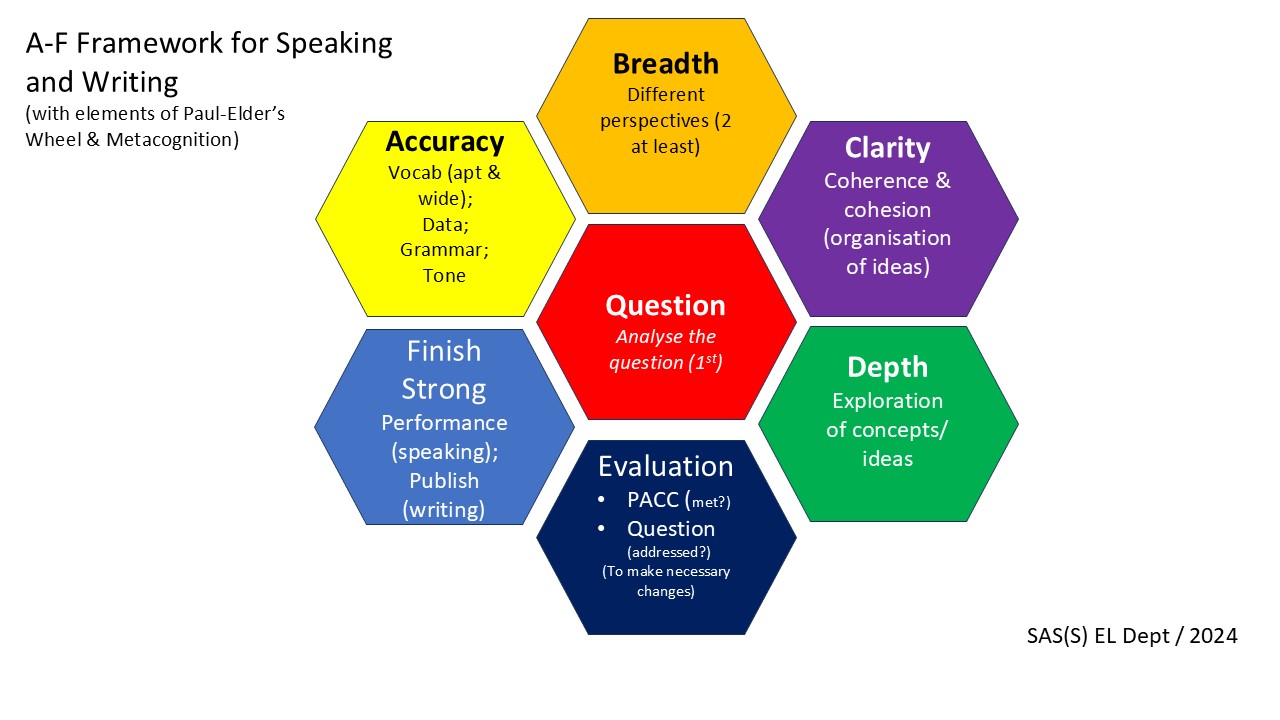
The SAS(S) approach is informed by the belief that students learn best when they are aware of how they learn. The A-F Framework presents the rigour that undergirds the Saints EL experience:
Saints Read Programme
A cornerstone of the SAS(S) English curriculum, the Saints Read Programme nurtures discerning, informed, and reflective learners. Run during EL lessons, the programme engages students in topics of relevance. Students respond by producing artefacts of various modes such as journal writing, sharing reflections on Padlet, or delivering speeches. The process harnesses students’ interest in different topics, broadens their perspective, and invites them to delve into rich discourse on complex issues.
Literature
Through the study of Literature, we hope to inculcate in our boys a respect for the importance of reading widely and deeply, and to develop their ability to appreciate their ability to appreciate the subtle nuances that texts carry.
As teachers of English Literature, we believe in acting as role models displaying love for the creative play of language found in literary texts. We hope to open our students' eyes to the value of reading as an experience that enhances our understanding of others and ourselves.
Our Literature lessons are designed around two areas of focus:
5 Areas of Study in Literature
-
Plot: Elements of Plot; Conflict; Relationship between Scenes and text; Plot and Subplots; Narrative Structure; and Plot Devices
-
Character: Roles and Purposes of Character; Characterisation; Character Traits; Character Development; and Relationships
-
Theme: Central Ideas; and Main Concerns
-
Style: Diction; Sound; Point of View; Irony; Tone; Form; and Figurative Language
-
Setting & Atmosphere: Time; Place; Physical Details; Situations; and Mood
3 Principles of Literature Teaching and Learning
-
Personal Engagement: Engage with texts; develop individual responses to texts; and share and evaluate different viewpoints and perspectives
-
Critical Appreciation: Use of literary skills to analyse texts; and develop critical responses that are substantiated by textual evidence
-
Meaningful connections: Explore connections between literary texts and students' own lives or the rest of the world via texts set and written in different contexts and from various parts of the world
Lower Secondary Programme
Lower Secondary students go through a two-year programme where they are introduced to a wide variety of literary devices and themes through a study of texts in the three genres: prose, poetry and drama. They are also equipped with essay writing skills to respond to unseen prose and poetry.
Upper Secondary Elective
The Upper Secondary Literature Elective is a two-year course where students prepare for the National Examinations.